


Inclusive Remote and Hybrid Working Study
Access:
Members Only

Membership Required
This content is only visible to logged-in members
This is timely research. The disability employment gap is substantial (29.5 percentage points) and has changed little in decades. Rates of ill-health and economic inactivity have seen huge growth since the pandemic. Halving the disability employment gap alone would achieve the government’s ambition to increase national employment to 80%.
Our study:
Firstly, we explored disabled workers’ experiences of working remotely or in a hybrid way, and how those ways of working had impacted their work, health and wellbeing. In total, 1,221 disabled remote and hybrid workers completed our UK-wide survey and 45 of these participants were interviewed.
Secondly, we conducted interviews and case studies with organisations regarding how and why they had implemented remote and hybrid models. 45 interviews were conducted with leaders, managers and HR professionals from 27 organisations.
Most disabled workers reported that remote or hybrid working had positively impacted their:
- mental health, physical health and ability to manage impairments/health conditions
- work-life balance, caring or parenting responsibilities
- productivity and ability to complete tasks.
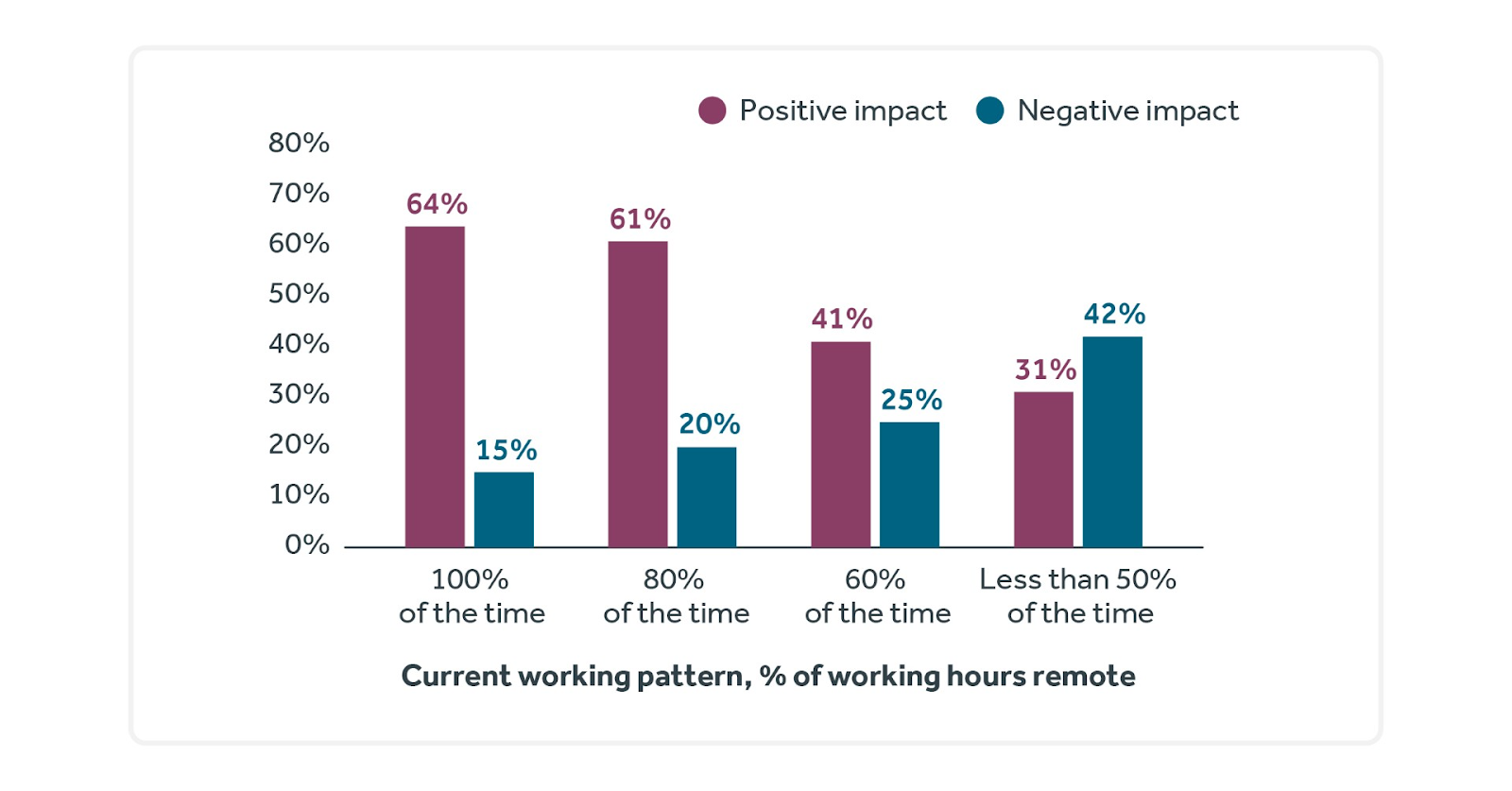
Those working remotely more often were more likely to report positive impacts. For example:
- 64% of participants working solely from home reported their remote or hybrid working pattern has positively affected their physical health, compared to only 31% of those working from home for less than half their time. Reports of a negative impact on physical health increased as time spent working from home declined.
Why did we find these positive impacts?
- Most participants felt their home was more suited to their needs than the office. Working remotely often made it easier to focus, engage in self-care, and work around pain, fatigue and mobility issues. For some, this supported their job retention and reduced their sick leave.
This has important implications for recruitment and retention:
- Only 1.6% wanted to return to solely onsite working.
- 85% reported having access to remote or hybrid working would be essential or very important if looking for a new job.
- 79% would not apply for a job without remote options.
We also identified important challenges:
- 47% of participants had not received in full their requested reasonable adjustments, placing them at risk of work-related illness and injury.
- Black and minority ethnic workers and less affluent workers were significantly less likely than white or more affluent workers to report remote/hybrid working had positive outcomes for their health and employment.
Our interviews with representatives from the 27 organisations revealed that:
- Remote and hybrid working had often been implemented to support staff retention and recruitment.
- Benefits of implementing remote or hybrid models included reduced sick leave, improved wellbeing and better work-life balance.
- Productivity had increased or stayed the same since implementing remote or hybrid models.
However, monitoring the health and wellbeing of remote staff was cited as a challenge due to reduced visibility, and some organisations acknowledged disconnections between policy and practice could have negative implications for disabled staff, as their ability to work from home can be dependent on managers’ attitudes to it.
Inclusive practice within these organisations included offering flexibility over work location, exempting disabled staff from hotdesking, implementing reasonable adjustments and flexible working requests, holding meetings in hybrid rather than in-person format, and designing office space to meet disabled workers’ needs.
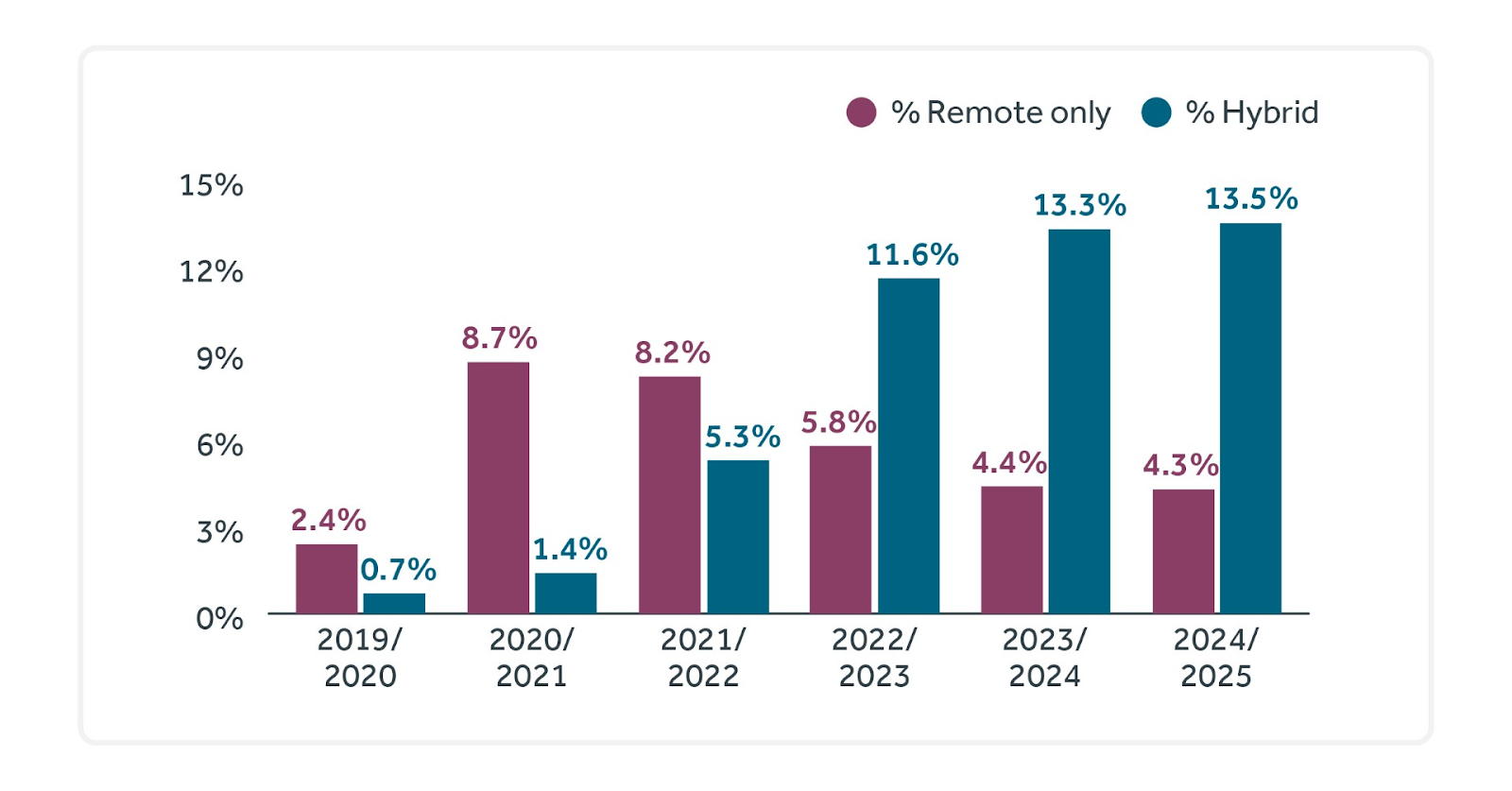
Although we found remote and hybrid working is important for disabled workers’ health, work and productivity, and for organisational recruitment and retention, our analysis of Adzuna jobs vacancy data revealed that remote working opportunities have declined since initial growth following the pandemic, and the growth in hybrid roles has stalled.
It is important that we see expansion in remote and hybrid roles to better support the employment and wellbeing of disabled workers – and others who need flexible working conditions – and for organisations to attract and retain their workforce. We also need to see organisations taking the implementation of reasonable adjustments seriously; 47% of the disabled people in our study were working without full implementation of their requested adjustments, and many highlighted the difficulties they had encountered in securing support from the Access to Work scheme.
Policy implications: The Government wants to support more disabled people into work and tackle health-related economic inactivity. To achieve this, it is imperative that it:
- Ensures that employers address onsite accessibility.
- Expands the availability of remote and hybrid jobs (and other forms of flexible working) to boost disabled people’s job opportunities.
- Ensures employers consider remote/hybrid working when implementing reasonable adjustments.
- Ensures employers address workplace inaccessibility, which can pose a barrier to onsite working.
- Fully invests in the Access to Work scheme to ensure disabled workers to better support disabled workers and job applicants to work in remote or hybrid roles.
To read more about our findings, please visit the study website , which provides links to Reports and media from the Inclusive Remote and Hybrid Working Study . These reports and media include:
- Our final report, which was launched this week and is also available here: Breaking down barriers: How remote and hybrid work can support disabled workers - Lancaster University
- The final report was covered in an exclusive Guardian article on Saturday: Decline in remote jobs risks shutting disabled people out of work, study finds | Disability | The Guardian
- Our interim report (March 2025) is also available.
- Some of the disabled workers and organisations we interviewed for the study took part in a short film.
- As project lead, I gave evidence from the study to the House of Lords Select Committee on Home-based Working. The recording of the live session is here (the 3.20pm session): 31 March 2025 - Home-based Working - Oral evidence - Committees - UK Parliament and our written evidence is available here: committees.parliament.uk/writtenevidence/141006/html/
Lastly, if you would like to hear more about our findings, I’ll be presenting at a webinar on Tuesday 24 March (11.00-12.00). The webinar invite and link to register follows:
Is the rise in remote and hybrid work in the UK now under threat?
Six years on from the first Covid-19 lockdown, working from home has become a mainstream practice, with many employers moving beyond initial emergency measures and actively redesigning roles to support flexible working. But more employers are calling staff ‘back to the office’, with a sharp fall in remote vacancies in recent months.
It has represented a significant shift in the lives of millions of UK workers with one in five workers now working mainly from home, compared to just one in twenty in 2019. Join the Work Foundation at Lancaster University and an expert panel to explore the future of remote and hybrid work in the UK, and how it can be utilised to improve access to secure and flexible employment in the years ahead. Confirmed speakers include Baroness Needham-Scott (Chair, Lords Homebased Working Committee), Dr Paula Holland (Senior Lecturer in Public Health, Lancaster University) and Ben Harrison (Director, Work Foundation at Lancaster).
All the best and please get in touch if you have any questions.
Paula Holland
www.linkedin.com/in/dr-paula-holland-phd
Additional Categories:

Downloads
Review and download pdf's and other resources below...

This is timely research. The disability employment gap is substantial (29.5 percentage points) and has changed little in decades. Rates of ill-health and economic inactivity have seen huge growth since the pandemic. Halving the disability employment gap alone would achieve the government’s ambition to increase national employment to 80%.
Our study:
Firstly, we explored disabled workers’ experiences of working remotely or in a hybrid way, and how those ways of working had impacted their work, health and wellbeing. In total, 1,221 disabled remote and hybrid workers completed our UK-wide survey and 45 of these participants were interviewed.
Secondly, we conducted interviews and case studies with organisations regarding how and why they had implemented remote and hybrid models. 45 interviews were conducted with leaders, managers and HR professionals from 27 organisations.
Most disabled workers reported that remote or hybrid working had positively impacted their:
- mental health, physical health and ability to manage impairments/health conditions
- work-life balance, caring or parenting responsibilities
- productivity and ability to complete tasks.
Those working remotely more often were more likely to report positive impacts. For example:
- 64% of participants working solely from home reported their remote or hybrid working pattern has positively affected their physical health, compared to only 31% of those working from home for less than half their time. Reports of a negative impact on physical health increased as time spent working from home declined.
Why did we find these positive impacts?
- Most participants felt their home was more suited to their needs than the office. Working remotely often made it easier to focus, engage in self-care, and work around pain, fatigue and mobility issues. For some, this supported their job retention and reduced their sick leave.
This has important implications for recruitment and retention:
- Only 1.6% wanted to return to solely onsite working.
- 85% reported having access to remote or hybrid working would be essential or very important if looking for a new job.
- 79% would not apply for a job without remote options.
We also identified important challenges:
- 47% of participants had not received in full their requested reasonable adjustments, placing them at risk of work-related illness and injury.
- Black and minority ethnic workers and less affluent workers were significantly less likely than white or more affluent workers to report remote/hybrid working had positive outcomes for their health and employment.
Our interviews with representatives from the 27 organisations revealed that:
- Remote and hybrid working had often been implemented to support staff retention and recruitment.
- Benefits of implementing remote or hybrid models included reduced sick leave, improved wellbeing and better work-life balance.
- Productivity had increased or stayed the same since implementing remote or hybrid models.
However, monitoring the health and wellbeing of remote staff was cited as a challenge due to reduced visibility, and some organisations acknowledged disconnections between policy and practice could have negative implications for disabled staff, as their ability to work from home can be dependent on managers’ attitudes to it.
Inclusive practice within these organisations included offering flexibility over work location, exempting disabled staff from hotdesking, implementing reasonable adjustments and flexible working requests, holding meetings in hybrid rather than in-person format, and designing office space to meet disabled workers’ needs.
Although we found remote and hybrid working is important for disabled workers’ health, work and productivity, and for organisational recruitment and retention, our analysis of Adzuna jobs vacancy data revealed that remote working opportunities have declined since initial growth following the pandemic, and the growth in hybrid roles has stalled.
It is important that we see expansion in remote and hybrid roles to better support the employment and wellbeing of disabled workers – and others who need flexible working conditions – and for organisations to attract and retain their workforce. We also need to see organisations taking the implementation of reasonable adjustments seriously; 47% of the disabled people in our study were working without full implementation of their requested adjustments, and many highlighted the difficulties they had encountered in securing support from the Access to Work scheme.
Policy implications: The Government wants to support more disabled people into work and tackle health-related economic inactivity. To achieve this, it is imperative that it:
- Ensures that employers address onsite accessibility.
- Expands the availability of remote and hybrid jobs (and other forms of flexible working) to boost disabled people’s job opportunities.
- Ensures employers consider remote/hybrid working when implementing reasonable adjustments.
- Ensures employers address workplace inaccessibility, which can pose a barrier to onsite working.
- Fully invests in the Access to Work scheme to ensure disabled workers to better support disabled workers and job applicants to work in remote or hybrid roles.
To read more about our findings, please visit the study website , which provides links to Reports and media from the Inclusive Remote and Hybrid Working Study . These reports and media include:
- Our final report, which was launched this week and is also available here: Breaking down barriers: How remote and hybrid work can support disabled workers - Lancaster University
- The final report was covered in an exclusive Guardian article on Saturday: Decline in remote jobs risks shutting disabled people out of work, study finds | Disability | The Guardian
- Our interim report (March 2025) is also available.
- Some of the disabled workers and organisations we interviewed for the study took part in a short film.
- As project lead, I gave evidence from the study to the House of Lords Select Committee on Home-based Working. The recording of the live session is here (the 3.20pm session): 31 March 2025 - Home-based Working - Oral evidence - Committees - UK Parliament and our written evidence is available here: committees.parliament.uk/writtenevidence/141006/html/
Lastly, if you would like to hear more about our findings, I’ll be presenting at a webinar on Tuesday 24 March (11.00-12.00). The webinar invite and link to register follows:
Is the rise in remote and hybrid work in the UK now under threat?
Six years on from the first Covid-19 lockdown, working from home has become a mainstream practice, with many employers moving beyond initial emergency measures and actively redesigning roles to support flexible working. But more employers are calling staff ‘back to the office’, with a sharp fall in remote vacancies in recent months.
It has represented a significant shift in the lives of millions of UK workers with one in five workers now working mainly from home, compared to just one in twenty in 2019. Join the Work Foundation at Lancaster University and an expert panel to explore the future of remote and hybrid work in the UK, and how it can be utilised to improve access to secure and flexible employment in the years ahead. Confirmed speakers include Baroness Needham-Scott (Chair, Lords Homebased Working Committee), Dr Paula Holland (Senior Lecturer in Public Health, Lancaster University) and Ben Harrison (Director, Work Foundation at Lancaster).
All the best and please get in touch if you have any questions.
Paula Holland
www.linkedin.com/in/dr-paula-holland-phd
Additional Categories:
Downloads
Review and download pdf's and other resources below...
Discover the latest related resources
Based on current viewing you may also be interested in these...
Multiple Sclerosis and Sustainable Employment: How Vocational Rehabilitation Can Help Prevent Job Loss

Access:
Members Only
Discover how vocational rehabilitation can support people with MS to remain in work through fatigue management, reasonable adjustments and tailored employment support.
The Importance of Effective Supervision in Vocational Rehabilitation Practice & How the VRA Can Help
Access:
Members Only
In this demanding profession, effective supervision is essential for maintaining high standards of practice and supporting professional development
Swiss Re Group Watch 2026 – Post‑Event Summary

Access:
Members Only
The VRA was delighted to host Ron Wheatcroft and Keith Williams from Swiss Re for an exclusive briefing on the newly published Group Watch 2026 report.
Get In Touch
Got a question or need some help? Please feel free to contact a us and a member of the team will get back to you asap!
VRA – Informed Consent GuideVRA Policies


